
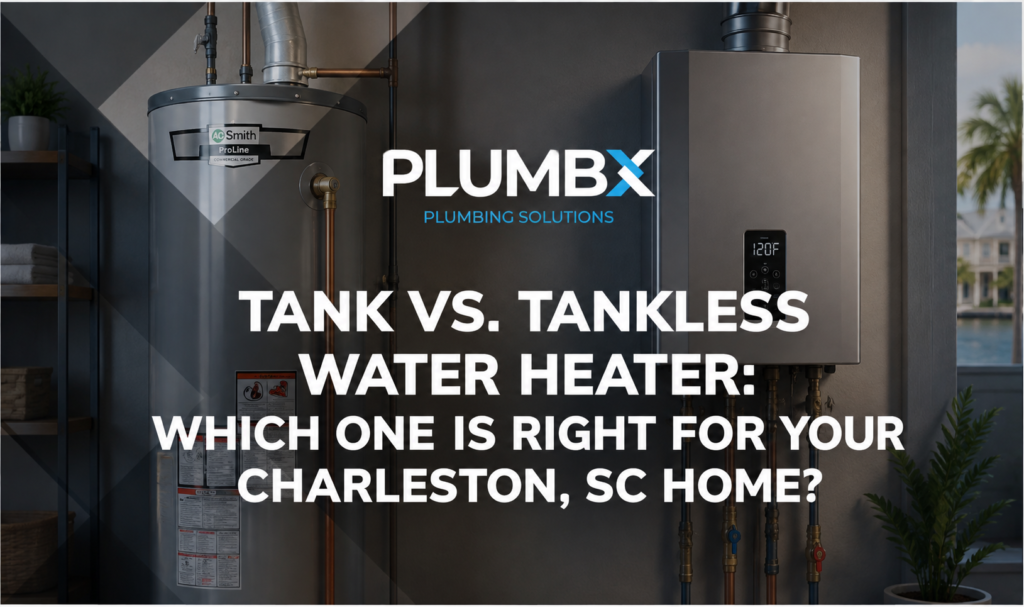
Most homeowners never think about their water heater until it stops working. Then, standing under a cold shower or staring at a puddle in the utility closet, they must make a big decision fast: repair the old tank, or switch to something new.
If you live in Charleston, SC, that decision comes with a few local wrinkles. Coastal humidity, hard water, and a hurricane season that puts extra strain on every mechanical system in the house all factor into which water heater makes sense for your home. Before your current unit forces the choice on you, it is worth understanding what a tank and a tankless system do differently, and which one fits your household. PlumbX installs and repairs both types across the Charleston metro every week, and the honest answer is that neither system is universally better. The right one depends on your home, your household, and your budget. This guide compares a tank vs tankless water heater side by side so you can make that call with real numbers.
How a Tank and a Tankless Water Heater Actually Work
A traditional tank water heater stores 30 to 50 gallons of hot water and keeps it heated around the clock, so it is ready the moment you turn on a faucet. That convenience has a cost. Even a well-insulated tank loses heat over time, so the burner or heating element must keep firing to make up the difference. This is called standby loss, and it is the main reason tank units cost more to run over the course of a year.
A tankless, or on-demand, water heater skips the storage step entirely. Cold water runs through a compact heat exchanger only when you open a hot water tap, and a gas burner or electric element heats it instantly as it passes through. Because there is no standing tank to keep warm, there is no standby loss. The unit only draws energy when someone in the house is using hot water.
Both systems can run on gas or electric, and both can serve a home reliably for years when they are sized and installed correctly. The real differences show up in the numbers.
Tank vs Tankless Water Heater: Cost, Efficiency, and Lifespan
Numbers matter more than opinions here, so let’s start with efficiency. According to the U.S. Department of Energy’s Energy Saver program, tankless water heaters are 24 to 34 percent more energy efficient than storage tank units for households using 41 gallons or less of hot water per day, which covers most couples and small families with moderate use. For larger households using around 86 gallons a day, the efficiency gain narrows to 8 to 14 percent. Still real savings, just a smaller share of your utility bill.
To put that in dollars, the Department of Energy estimates water heating accounts for roughly 13 to 18 percent of a typical home’s total energy use, and the average household spends $400 to $600 a year heating water. Applied to that range, a 24 to 34 percent efficiency gain could translate to roughly $100 to $200 in savings annually for a smaller household, though your actual number depends on your fuel type, local utility rates, and how much hot water your family uses.
Lifespan is where tankless systems separate from tank units most clearly. A standard tank water heater typically lasts 10 to 15 years before it needs replacing. A well-maintained tankless unit can last 20 to 30 years, roughly double. Over the life of a home, that can mean replacing a tank system twice for everyone tankless installation.
Upfront cost tells a different story. A standard 50-gallon tank installation in the Charleston area typically runs $1,200 to $2,500. A tankless installation costs more upfront, generally $3,500 to $6,500, since it often requires new venting, gas line, or electrical upgrades to meet the unit’s demands. Homes that install a tankless unit at each point of use, rather than one central unit for the whole house, can push total energy savings up to 27 to 50 percent, though that approach also raises the initial investment.
Space is the easiest comparison to make. A tank needs a dedicated closet or utility room footprint that never shrinks. A tankless unit mounts flat on a wall and takes up a fraction of that space, which matters in a downtown Charleston condo, a carriage house, or an older home where utility space was never designed with modern systems in mind.
| Tank | Tankless | Notes | |
| Upfront Install Cost | $2,800–$4,500 | $4,500–$6,500 | Tankless often needs new venting/electrical |
| Efficiency Gain | Baseline | +24–34% (small use) / +8–14% (high use) | U.S. DOE, Energy Saver |
| Typical Lifespan | 10–15 years | 20–30 years | Roughly double with maintenance |
| Space Needed | Full closet/utility footprint | Wall-mounted, minimal footprint | Good for condos, tight utility rooms |
Which One Fits Your Household?
If you have a smaller household with moderate hot water use, such as one or two people and a single bathroom with no overlapping showers, a tank system’s lower upfront cost may pay for itself before a tankless unit’s efficiency gains catch up.
If you have a larger family, run multiple showers and a washing machine at the same time, or simply never want to run out of hot water mid-shower, tankless makes a stronger case. It delivers hot water on demand regardless of how many fixtures are running, if the unit is sized correctly for your home’s peak demand.
There is no universal right answer, and any blog that tells you otherwise is oversimplifying. The correct choice depends on household size, how much hot water your family uses during peak hours, and how long you plan to stay in the home. Someone renovating a forever home has a different payback calculation than someone preparing a rental property for new tenants. It is also worth considering resale value: buyers increasingly ask about tankless systems during home inspections in the Charleston market, and a properly installed tankless unit can be a selling point, though it rarely changes an offer on its own.
Before you decide, run through a short checklist with whoever installs the system: how many bathrooms run hot water at once during a typical morning, whether the home has natural gas or only electric service, and whether the utility space can accommodate a tankless unit’s venting requirements without a costly retrofit. Skipping this step is the single biggest reason homeowners end up unhappy with either choice.
Not sure which system fits your home?
Request a free water heater evaluation and PlumbX will walk you through the real numbers for your specific household before you spend a dollar.
Schedule your evaluation →
Does Charleston’s Climate Change the Equation?
Coastal South Carolina is hard on water heaters generally. Salt air and high humidity accelerate corrosion on tank and tankless units alike, which is one reason PlumbX recommends professional installation with proper venting and moisture protection rather than a generic, big-box setup that was not designed for a Lowcountry climate.
Hard water is the bigger factor for most homeowners. Minerals in local water build up as scale inside any water heater, but they build up faster inside a tank, where water sits still and minerals settle to the bottom. Tankless units are less prone to heavy sediment buildup because water passes through rather than pooling, but scale can still coat the heat exchanger over time and gradually reduce efficiency if the unit is never descaled.
The fix is straightforward. Pair a tankless installation with a water softener and schedule an annual descaling. If you read our earlier guide on whether to upgrade to a water softener, you already know a softener protects fixtures and pipes throughout the house. A tankless water heater is one more system that benefits directly from softened water, often extending its operating life by a couple of years.
Hurricane season adds one more variable specific to the Lowcountry. Most tankless water heaters, gas or electric, rely on an electronic ignition system and control board that need electricity to function, so a tankless unit will not produce hot water during a power outage unless the home has backup power. Many tank units with a standing pilot light can still deliver hot water during a short outage, which is worth weighing if you live in an area prone to extended storm-related outages. Neither system is immune to storm damage, but it is a real factor in the tank versus tankless decision for coastal homes.
Signs Your Current Water Heater Is Telling You It’s Time
A few signs mean it is time to stop repairing and start planning a replacement. Your water heater is a decade or older if it is a tank unit, or approaching the 20-year mark with reduced flow if it is tankless. Hot water runs rusty or discolored, especially right when you turn on the tap. You hear popping or rumbling sounds, a common sign of sediment buildup inside a tank. Water is pooling around the base of the unit, which always means replace rather than repair. Hot water temperature swings or pressure noticeably drops during normal use.
Catching these signs early gives you time to compare tank and tankless options on your own schedule, instead of making an emergency decision the day your water heater actually fails.
Waiting until a water heater fails outright is the most expensive way to replace one. An emergency replacement often means accepting whatever unit is in stock that day, paying rush labor rates, and dealing with water damage cleanup on top of the replacement cost. Homeowners who plan ahead, by comparison, can compare tank and tankless pricing, schedule the installation around their calendar, and avoid a cold shower emergency entirely.
What to Expect When PlumbX Installs Your Water Heater
Every water heater installation starts with an honest assessment. Our technicians look at your household’s hot water demand, your home’s existing venting and electrical or gas capacity, and your water quality before recommending anything. From there, we walk you through the tank versus tankless comparison specific to your house, not a generic recommendation copied from a sales script.
Installation itself typically takes a few hours for a straightforward tank replacement and closer to half a day for a tankless conversion, since that often involves new venting or gas line work. We test the completed system fully before we leave, and we walk you through basic maintenance, including when to schedule descaling if you choose a tankless unit.
Once installed, plan on an annual flush and inspection for a tank unit, and an annual descaling for a tankless unit in most Charleston-area homes, more often if your water is especially hard. Skipping this step is the single most common reason either system underperforms its expected lifespan.
PlumbX is a licensed South Carolina mechanical contractor, veteran-owned and employee-owned, which means the technician at your door has a direct stake in doing the job right the first time. We pull the required permits and schedule the necessary inspections so your installation is fully compliant from day one, something not every plumbing outfit in the Lowcountry can say, and it matters if you ever sell the home or file an insurance claim tied to water damage. We also stand behind every installation with a workmanship warranty separate from the manufacturer’s equipment warranty, and we will explain both in plain language before we start any work.
Get a Straight Answer for Your Home
There is no single best tank vs tankless water heater. There is a best water heater for your household, your budget, and Charleston’s coastal climate. PlumbX installs and services both tank and tankless systems throughout North Charleston and the greater Lowcountry, and we will give you real numbers instead of a sales pitch.
Request your free water heater evaluation today.
Call PlumbX at 843-405-8800 or contact us online to get started.
Email: hello@plumbx.com