
Every restaurant kitchen has one piece of equipment nobody wants to think about. It sits under a sink or buried out back, and it only gets attention when something goes wrong: a sour smell in the dining room, a floor drain backing up during Friday dinner service, or an inspector asking to see your pump-out log. Regular grease trap maintenance Charleston SC restaurants can count on is what keeps those moments from happening.
Below, we break down how a grease trap works, what Charleston-area sewer utilities require, and what neglect really costs.
1. What a Grease Trap Does
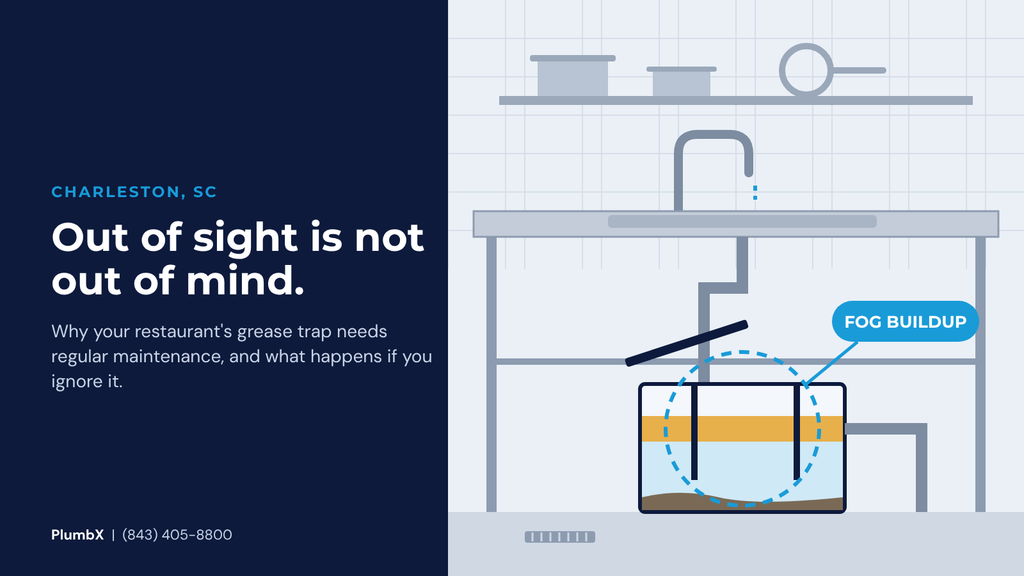
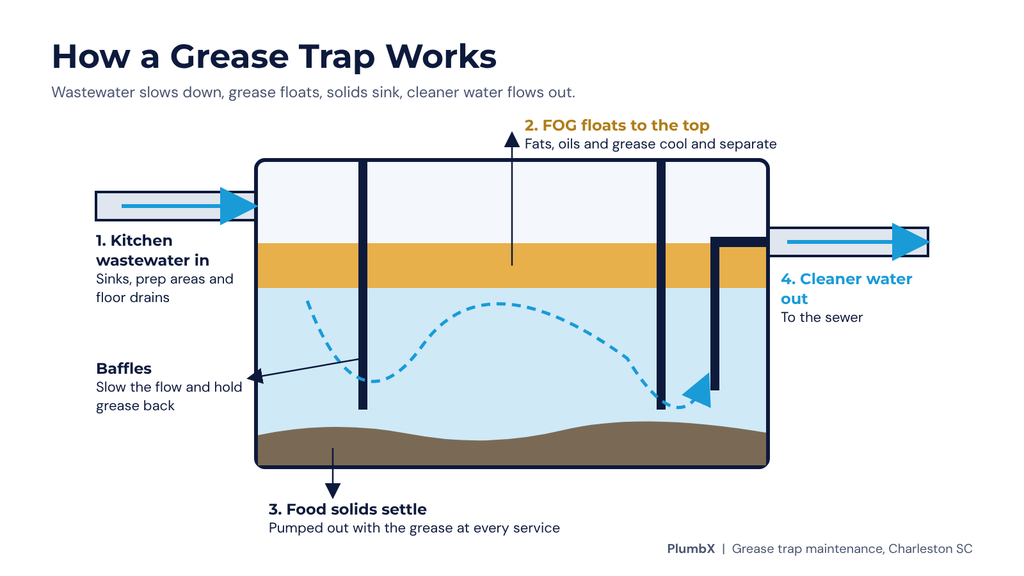
Every time your team rinses a pan, scrapes a plate, or runs a prep sink, fats, oils, and grease (FOG) go down the drain. A grease trap slows that wastewater down so the FOG cools, floats to the top, and gets held back while cleaner water flows out to the sewer.
Smaller units sit under sinks inside the kitchen. Larger in-ground grease interceptors sit outside and handle higher volumes. Both types need routine grease interceptor service Charleston inspectors will check for. Either way, the trap only works while it has room to hold more grease. Once it fills up, grease passes straight through into your lines and the public sewer.
The U.S. Environmental Protection Agency reports that grease from restaurants, homes, and industrial sources is the most common cause of reported sewer blockages, at 47%, because it “solidifies, reduces conveyance capacity, and blocks flow.”
2. What Charleston-Area FOG Rules Require
Every FOG program South Carolina utilities run is a little different. Which rules apply depends on who provides your sewer service. Here is what the two main local utilities publish.
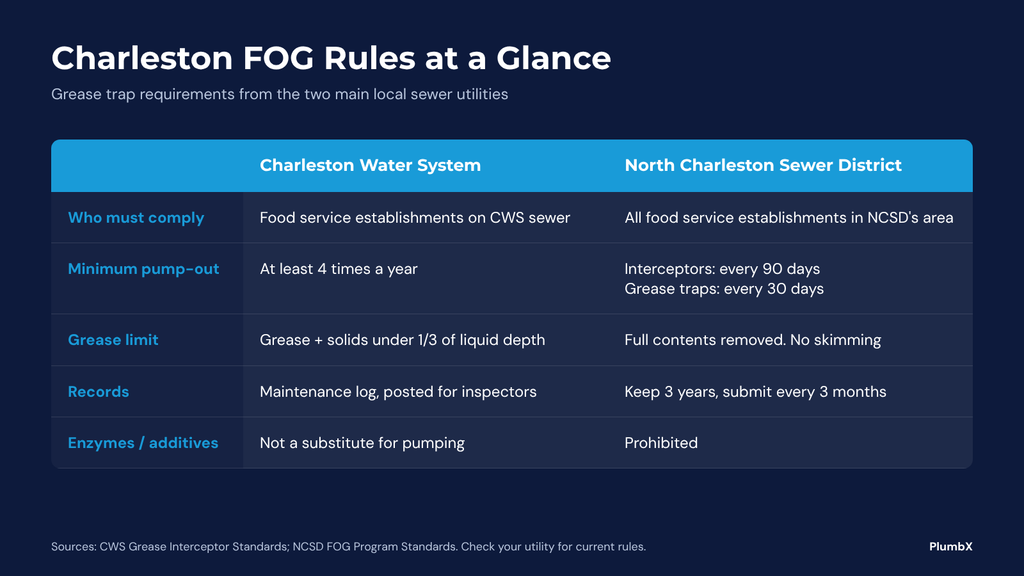
Charleston Water System. Charleston Water System requires food service establishments connected to its sewer to install and maintain a grease trap, and to have it “thoroughly pumped out and/or cleaned at least four times a year,” or more often if its inspector decides. Its Grease Interceptor Standards also say the grease layer plus settled solids should never exceed one-third of the trap’s normal liquid depth, and that pump-outs must be recorded on a maintenance log kept available for inspection.
North Charleston Sewer District. The North Charleston Sewer District’s FOG Program Standards require every food service establishment in its service area to have an approved grease trap or interceptor, with interceptors pumped at least every 90 days and smaller grease traps at least every 30 days. NCSD also requires cleaning records to be kept for three years and copies submitted every three months.
Both utilities agree on one thing: enzymes, bacteria, or other additives are not a substitute for physically pumping the trap. NCSD also prohibits skimming the top layer instead of removing the full contents. Whichever utility serves you, documented grease trap maintenance Charleston SC inspectors can verify is what keeps you compliant.
3. What Happens If You Ignore It
Fines and fees. According to the North Charleston Sewer District’s food service requirements, violations are fined $100 for the first offense, $250 for the second, and $500 for the third and each one after that, plus a $45 re-inspection fee. NCSD notes its rates can change.
Paying for the sewer’s damage, too. Charleston Water System’s standards state that restaurants whose grease builds up in the public lines are liable for related service calls, line cleaning, pump repairs, and property damage. That bill lands on top of your own plumbing repair.
Losing service or your permit. Repeated unsatisfactory inspections can lead to discontinued water or sewer service under both utilities’ standards. They can also refer the case to health authorities, which can lead to revocation of your food service permit.
Backups during service. Before any of that, a full trap backs up into floor drains and sinks. That means wastewater on the kitchen floor, closed stations, and comped meals, often on your busiest night.
Ready to get ahead of your next inspection? Schedule grease trap maintenance Charleston SC kitchens rely on with PlumbX or call (843) 405-8800.
4. Signs Your Grease Trap Needs Service Now
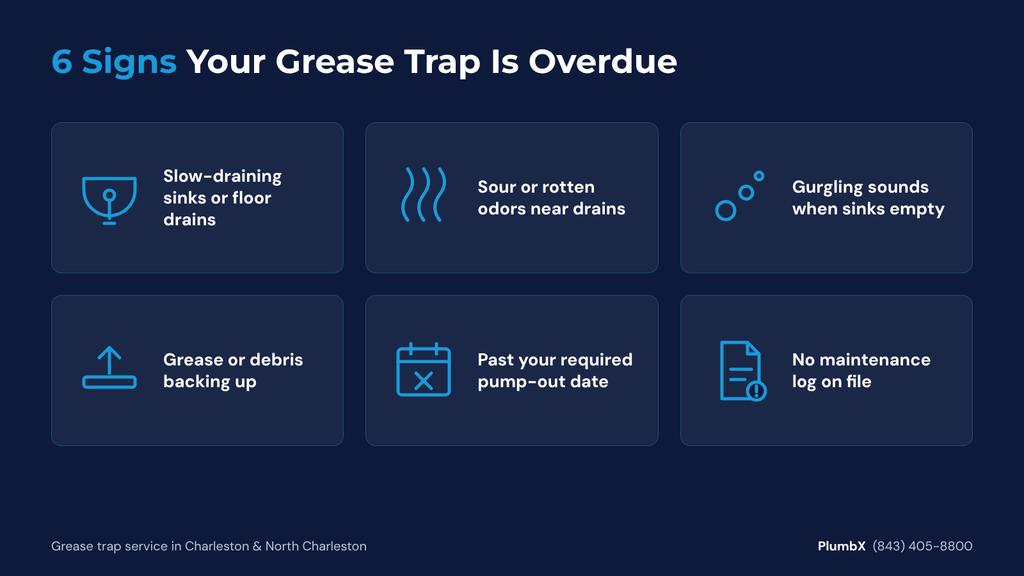
Any one of these means it’s time for grease trap cleaning North Charleston and Charleston kitchens shouldn’t put off:
- Slow-draining sinks or floor drains anywhere in the kitchen
- Rotten or sour odors near drains, the trap lid, or the dining area
- Gurgling sounds from drains when sinks empty
- Grease or food debris coming back up through floor drains
- It’s been longer than your utility’s required interval since the last pump-out
- You can’t find your maintenance log or last service record
5. Grease Trap Maintenance Charleston SC Schedules: How Often to Pump
Start with your utility’s minimum: four times a year with Charleston Water System, or every 90 days for interceptors and every 30 days for smaller traps with NCSD. Then adjust for how your kitchen actually runs.
The EPA notes that required maintenance frequency “depends greatly on the amount of FOG a facility generates” and on the best practices a kitchen follows. A high-volume fryer operation will need service more often than a coffee shop. Scraping plates into the trash, wiping pans before washing, and recycling used fryer oil all slow down how fast your trap fills.
6. How PlumbX Keeps Your Kitchen Compliant
PlumbX handles the grease trap maintenance Charleston SC restaurants need, covering both under-sink traps and outdoor in-ground interceptors across Charleston, North Charleston, and the Lowcountry.
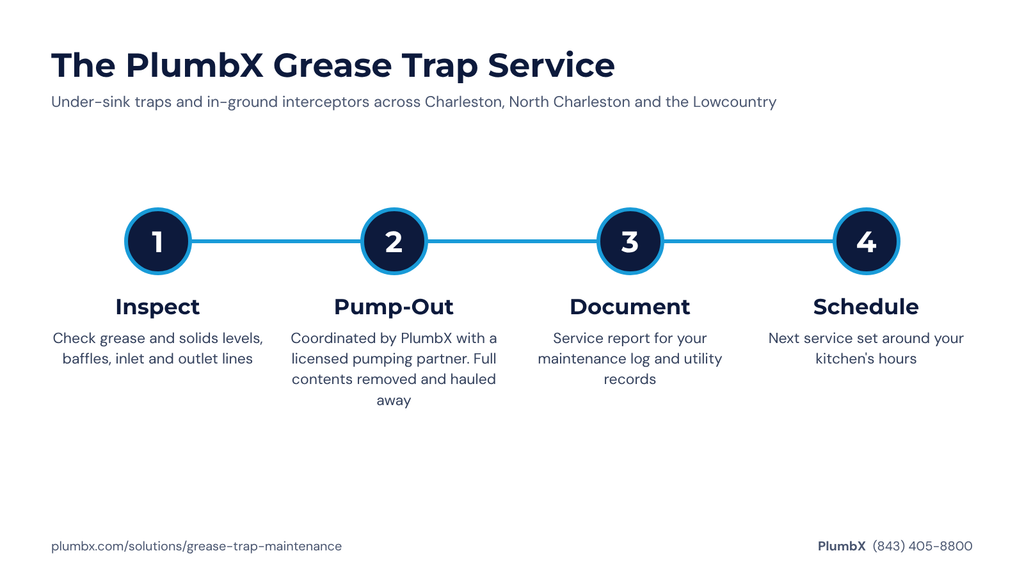
- Inspection. We check grease and solids levels, baffles, and inlet and outlet lines.
- Full pump-out, coordinated by PlumbX. We schedule the pump-out with a licensed pumping partner, who removes the entire contents, not just the top layer, and hauls the waste away for disposal in line with local regulations.
- The plumbing side. Our plumbers take care of the trap’s lines, baffles, and inlet and outlet connections.
- Service report. You get documentation for your maintenance log and your utility’s records.
- Flexible scheduling. We work around your hours so the kitchen keeps running.
And because PlumbX is a full restaurant plumbing service Charleston kitchens use for much more than grease traps, the help doesn’t stop there. When grease has already built up past the trap, our commercial kitchen drain cleaning and hydro-jetting services clear the branch lines. (Here’s why hydro-jetting beats chemical drain cleaners on grease.) If a backup hits mid-service, our emergency plumbing team is available 24/7.
Stay Inspection-Ready Year-Round
Your grease trap is easy to forget until it costs you a fine, a backup, or a night of service. Staying on top of grease trap maintenance Charleston SC rules require keeps your kitchen running, your records inspection-ready, and your relationship with the sewer utility uneventful. That’s exactly how it should be.
Schedule your next grease trap service with PlumbX
Call PlumbX at 843-405-8800 or contact us online to get started.
Email: hello@plumbx.com